A Brief Chronology of Catholic Oxford

Early Middle Ages: the beginnings of the University

912 First mention of Oxford, in the Saxon Chronicle, when it is recovered from the Danes by King Ethelred

1120 Theobald of Etampes teaching at a school with '60 or 100 clerks more or less'. Since no foundation of such a school is likely between 1066 and 1120, this school probably dates from before the Norman Conquest. This gives some plausibility to the tradition of a foundation by King Alfred the Great.

1161 English students banned from Paris by Henry II. Many of these congregated in Oxford: this is one explanation of the rise of Oxford as a centre of scholarship.

c.1195 St Edmund of Abingdon studies at Oxford, on the site which developed into St Edmund's Hall.

1221 Party of the newly founded Dominican 'Order of Preachers', the 'Blackfriars', set off to found a house of studies in Oxford. They establish themselves first in Jewish quarter, then move to area around Speedwell Street.

1225 Franciscan friars, the 'Greyfriars', found a house of studies in Oxford, in St Ebbes / Westgate.

1249 University College ('The Great Hall of the University') founded, to support ten masters.

1263 Balliol College founded (by John de Baliol, King of Scotland), as a hall of residence for poor scholars.

1264 Merton College founded, the first college to combine masters and students in one institution.

1281 Benedictine monks of Gloucester Cathedral found a house of studies, Gloucester Hall (where Worcester College now stands). This is soon used by many Benedictine houses of the South and West.

1281 Cistercians found Rewley Abbey as a house of studies. Later, they found St Bernard's College, where St John's now stands.

1286 Durham College (where Trinity College now stands) founded, a house of studies for the Benedictines of Durham Cathedral and the North.

1310 Duke Humphrey's Library founded.

1314 Exeter college founded, to train priests for the diocese of Exeter.

1326 Oriel College founded, for secular clergy of all dioceses.

1340 The Queen's College founded, for the secular clergy of the North.

Reconstruction after the Black Death (1347 - 1350)

1362 Canterbury Hall founded, a house of studies for the Benedictines of Canterbury Cathedral, and the secular clergy of the Province of Canterbury

1379 New College founded, for the secular clergy of the South.

1427 Lincoln College founded, for the secular clergy of the diocese of Lincoln.

1437 All Souls College founded as a community of scholar-priests, to say Masses for the dead of the war with France.

1448 Magdalen College founded

1509 Brasenose College founded, for the secular clergy.

1516 Corpus Christi College founded by Bishop Fox, especially for the study of Greek.

1526 Cardinal College founded by Cardinal Wolsey; refounded as Christ Church in 1546, by Henry VIII.

The Protestant Revolt

1530 Oxford delays its response to King Henry's question about the validity of his marriage to Katharine of Aragon; finally, the theology faculty, not the University, supplies the desired answer.

[1532 St Thomas More resigns as Lord Chancellor over the question of Henry VIII's divorce.]

[1533 Henry VIII marries Anne Boleyn and is excommunicated by Pope Clement VII; Cranmer appointed Archbishop of Canterbury.]

[1534 Act of Supremacy: Henry VIII declared Supreme Head of the Church of England.]

1535 College libraries ransaked. St Thomas More and St John, Cardinal Fisher beheaded.

1536 Dissolution of smaller monasteries in England, carried out by Thomas Cromwell. This leads to the Pilgrimage of Grace, centred in Yorkshire.

1538 Suppression of the Friars' houses in Oxford.

1539 Dissolution of the large religious houses. Abbots Blessed Richard Whiting (Glastonbury) and Blessed Hugh Farringdon (Reading), executed. Monastic colleges destroyed.

[1540 Carthusian martyrdoms in London.]

1541 Suppression of Shrines, including the shrine of St Frideswide in Oxford, located in Christ Church cathedral, which had been an important centre of pilgrimage. The valuables were confiscated and the shrine smashed to pieces.

1547 Edward VI, King of England and Supreme Head of the Church of England: Duke of Somerset acts as Protector. Chantries Act destroys the chantries and seizes their assets.

1553 Parish churches stripped of their valuables, as well as of devotional images and objects.

1549 First version of Book of Common Prayer. Royal policy said to be supported by only 2 of the 13 surviving heads of colleges. Riots in Oxford are quashed, and recalcitrant priests are hanged from their church spires in Chipping Norton and Bloxham. Heads of Catholics fastened to Oxford City walls. The Western Rising, in Devon and Cornwall, eventually crushed, leads to the fall of Somerset.

1552 new version of Book of Common Prayer, with unequivocally Protestant teachings on the Sacraments and so on.

Restoration of Catholicism: Mary Tudor: 1553-1558

1555 Trinity College and St John's College founded. The Dominican Peter de Soto teaches in Oxford.

Restoration of Protestantism: Elizabeth Tudor: 1558-1603

[1559 Act of Uniformity, passed by a margin of three votes, reimposes a slightly modified 1552 prayer-book; a wave of vandalism, by Protestant fanatics and royal officials, follows. Elizabeth is made the 'Supreme Governor' of the Church of England by the Act of Supremacy, which made Catholic resistance to Protestantism a capital offence. All but one of the bishops refused to co-operate; those unable to flee ended their days in prison.]

1559 Royal Commissioners visit Oxford; Catholic students imprisoned 'in great numbers.'

1561 William Allen, later Cardinal, resigns as head of St Mary's Hall, Oxford, and leaves the country. He later returns (still a layman) and encourages Catholics in the Oxford area and elsewhere. Six students imprisoned for resisting the removal of a chapel crucifix.

1565 Allen leaves England again, and with many other Oxford scholars he founds a Catholic University and seminary at Douay, in the Spanish Netherlands (1567). The seminary produced more than 160 martyrs for the Catholic faith. Other seminaries, monasteries and convents are founded by English Catholics overseas in the succeeding years.

[1569 Northern Rising, against the imposition of Protestantism.]

[1570 Pope St Pius V excommunicates Queen Elizabeth, and declares her deposed.]

1571 White Hall, an old hall of residence, refounded as Jesus College.

1574 Arrival in England of the first priests ordained at Douay for the English mission, who include a former fellow of St John's.

1577 Rowland Jenkins, an Oxford stationer, condemned to lose his ears for distributing Popish books, at the 'Black Assize'. Arrival in England St Ralph Sherwin, an alumnus of Exeter College. (Sherwin was martyred in 1581.)

1580 Arrival in England of the first Jesuit priests for the English mission, including St Edmund Campion, formerly Fellow of St John's, and Robert Persons, formerly Bursar of Balliol.

1580 Fr William Hartley sent to Oxford (Fr Arthur Pitts to Cambridge) to encourage vocation (Hartley was martyred in 1588).

1581 St Edmund Campion's book Decem Rationes left on the pews of the University Church in Oxford; later the same year he was martyred in London. Executions of Catholic priests, ordained overseas, and those who help them, frequent for the rest of Elizabeth's reign, and into that of James I.

1581 Undergraduates required to subscribe to the Thirty-Nine Articles of the Anglican Church. This requirement was abolished in 1871.

1587 Execution of the Catholic Mary Queen of Scots by Queen Elizabeth provokes war with Spain. William Allen created Cardinal in preparation for an anticipated Catholic restoration following a Spanish victory. Elizabeth's victory marked by savage persecution of Catholics: in the four months between 22 July and 27 November, of 1588, twenty-one seminary priests, eleven laymen, and one woman were put to death for their Catholic faith.]

1589 Martyrdoms of Blessed Nichols, Yaxley, Belson and Prichard in Oxford.

1602 Bodleian Library founded.

Stuart Dynasty

(James I: 1603-1625; Charles I: 1625-1649; Civil War starts 1642; Cromwell’s ‘Commonwealth’ 1649-1660; Charles II restored 1660-1685; James II 1685, expelled 1688.

1605 ‘Gunpowder Plot’: most famous of many real and imaginary ‘Popish plots’. The plotters had met in the Catherine Wheel Inn, now occupied by Balliol College.

1609 Douay translation of the Bible, prepared mainly by Catholic Oxford scholars working overseas, appears, two years before King James’ ‘Authorized Version’.

1610 Wadham College founded on ruins of the college of the Trinitarian Friars.

1610 Martyrdom of Blessed George Napier (Napper) in Oxford.

1621 Oxford Physic Garden, later called the Botanic Garden, founded.

1624 Broadgate Hall refounded as Pembroke College.

1625 Charles I becomes king; marries the Catholic Henrietta Maria, sister of Louis XIII of France, who prevents him signing the death warrants of captured priests.]

1642 Protestant fervour stirred by the beginning of the Civil War: Catholic books and pictures burned in the streets. Townsmen favour Parliament; the University the King. Oxford becomes the King’s headquarters. The King is forced by the Long Parliament to authorise executions of Catholic priests; a spate of martyrdoms is carried out around the country.

1644 Oxford falls to General Fairfax’s Parliamentarian troops. University and town purged of Royalists; 25 Anglican clergy ejected for their religious views.

1649 Leveller (Protestant extremist) troops of the Parliamentarian garrison of Oxford mutiny; two executed in Gloucester Green. Leveller unrest around the country.

1660 James II returns in triumph to London; Royalists and High Churchmen return from exile, and often to their positions in the University.

[1673 Test Act aims to deprive English Roman Catholics and Nonconformists of public office.]

1678 Titus Oates fabricates a ‘Popish plot’ to assassinate Charles II: anti-Catholic riots in Oxford, in which effigies of the Pope were burned; elsewhere in England the last martyrdoms are suffered as a result, 1679.

685 Charles II received into the Catholic Church on his deathbed. Succeeded by the Catholic James II.]

1687 James II issues Declaration of Liberty of Conscience, extends toleration to all religions.]

1688 James II’s contest with Magdalen College over his proposal for a Catholic Dean; Catholics head University College and Christ Church, and Mass said more openly. More anti-Catholic riots in Oxford precede the expulsion of James II. Test Act reimposed, and Catholic academics are forced to leave.

18th Century

1714 Worcester College founded, on ruins of Gloucester Hall

[1791 Catholic Relief Act legalises Catholic churches, and removes other restrictions on Catholics.]

1795 Chapel of St Ignatius, with a presbytery, was built, the first Catholic church in Oxford since the accession of Queen Elizabeth.

19th -20th Centuries

1817 George Canning rejected as Burgess of Oxford University, for his favouring a Catholic Emancipation Act

[1828 Test Act repealed; 1829 Catholic Emancipation Act removed most remaining legal restrictions on Catholics.]

1833-45 ‘Oxford Movement’ of prominent Anglican theologians, who attempted to reintroduce Catholic elements into their church. Many influenced by this, and some of its leaders, become Catholics, including the Venerable John Henry Newman, formerly Fellow of Oriel College and Vicar of St Mary’s (the University Church). He was received into the Church in 1845 while at Littlemore, outside Oxford.

1871 Thirty-Nine Articles no longer required of Undergraduates.

1875 Building of St Aloysius.

1895 Catholic Bishops allow Catholics to attend the Protestant University.

1895 Benedictines of St Lawrence’s Abbey, Ampleforth, found a house of studies in Oxford; it becomes a Hall of the University, and is known as St Benet’s Hall from 1920. (Halls were called by the name of their Master, e.g. ‘Hunter Blair Hall’, until in 1918 they could be ‘Permanent Private Halls’.)

1895 Jesuits establish a Hall of the University; known as Campion Hall from 1918.

1911 Building of St Edmund and St Frideswide, Iffley Road, and St Gregory and St Augustine, Woodstock Road

1929 Dominicans open Blackfriars as a house of studies; it becomes a Permanent Private Hall in the 1990s.

1931 Capuchin Franciscans take over St Edmund and St Frideswide, Iffley Road, and establish a house of studies; it becomes a Permanent Private Hall of the University in 1957.

(For more on Act of Parliament against Catholics, and the repeal of these, see here.)

  • THE WAY IN
  • THE MODERN GREYFRIARS
  • THE COWLEY FATHERS'€™ CHURCH
  • ST CLEMENTS
  • FROM ST CLEMENTS TO MANCHESTER COLLEGE
  • MANCHESTER COLLEGE
  • ST CROSS
  • HOLYWELL MANOR
  • MANSFIELD COLLEGE
  • KEBLE COLLEGE
  • ST GILES STREET
  • ST GILES€™ CHURCH
  • ST ALOYSIUS' €™CHURCH
  • ST JOHN'S COLLEGE
  • ST MARY MAGDALENE'€™S CHURCH
  • CORNMARKET STREET
  • ST MICHAEL'S CHURCH
  • BROAD STREET
  • BALLIOL COLLEGE
  • TRINITY COLLEGE
  • TURL STREET
  • JESUS COLLEGE
  • ST MILDRED'S CHURCH
  • LINCOLN COLLEGE
  • ALL SAINTS'™ CHURCH
  • EXETER COLLEGE
  • THE UNIVERSITY BUILDINGS
  • THE OLD ASHMOLEAN BUILDING
  • THE SHELDONIAN THEATRE
  • THE OLD CLARENDON BUILDING
  • THE DIVINITY SCHOOL AND CONVOCATION HOUSE
  • DUKE HUMPHREY'€™S LIBRARY AND THE BODLEIAN
  • THE RADCLIFFE CAMERA
  • BRASENOSE COLLEGE
  • ST MARY'S CHURCH
  • ORIEL COLLEGE
  • CORPUS CHRISTI COLLEGE
  • ST EDWARD THE MARTYR'S CHURCH
  • CANTERBURY HALL
  • ST FRIDESWIDE'€™S PRIORY
  • CHRIST CHURCH
  • MERTON COLLEGE
  • UNIVERSITY COLLEGE
  • THE QUEEN'S COLLEGE
  • ALL SOULS' COLLEGE
  • HERTFORD COLLEGE
  • WADHAM COLLEGE
  • NEW COLLEGE
  • ST PETER'€™S IN THE EAST
  • ST EDMUND HALL
  • FROM ST EDMUND HALL TO MAGDALEN COLLEGE
  • MAGDALEN COLLEGE
  • FROM MAGDALEN TO ST ALDATE'S STREET
  • THE CATHOLIC CHAPLAINCY
  • THE MEDIEVAL BLACKFRIARS
  • THE CRUTCHED FRIARS
  • PEMBROKE COLLEGE
  • CAMPION HALL
  • ST ALDATE'€™S CHURCH
  • ST MARTIN’S, CARFAX
  • FROM ST ALDATE'€™S TO ST EBBE'S
  • ST MARY'€™S COLLEGE
  • ST PETER LE BAILEY
  • ST EBBE'S CHURCH
  • THE OLD GREYFRIARS
  • THE FRIARS OF THE SACK
  • ST BUDOC'€™S CHURCH
  • THE CASTLE
  • ST THOMAS THE MARTYR
  • OSNEY ABBEY
  • REWLEY ABBEY
  • THE CARMELITE PRIORY
  • WORCESTER COLLEGE
  • THE MODERN BLACKFRIARS
  • Back to top
  • Powered by Blogger

    Dorchester

    From Goulder Chapter I: Places Visited on the Way to Oxford, Part 1.

    This is not, of course, Dorchester in Dorset, but the town of the same name which is situated on the River Thame, half a mile north of its confluence with the Thames.

    HISTORY

    There was a settlement at Dorchester during most of the last two thousand years before Christ. Indeed, it appears to have been one of the most important inhabited sites in the neighbourhood. The Romans fortified it, and traces of their ramparts still remain on the west and south sides of the town. A track, now overgrown with grass, can be distinguished branching off the main road at the north end of the place. It was the Roman road to Alchester near Bicester.
    In the first quarter of the seventh century, Pope Honorius I
    [1] charged a monk of St Andrew’s monastery on the Coelian Hill in Rome with the task of converting the people inhabiting the middle districts of England. His name was Birinus and he was consecrated a bishop by Asterius[2] of Milan. In 634, he landed at the head[3] of Southampton Water and, finding that the West Saxons living near the coast had not yet been converted, he turned his attention to them. In the same year, he baptized Cynegils,[4] king of Wessex. The ceremony took place at Dorchester, and St Oswald[5] of Northumbria, who was in the town to negotiate a marriage, acted as sponsor to Cynegils.
    St Birinus set up his cathedral at Dorchester and died there about 650. Soon after he was dead, his vast missionary diocese was divided. Hampshire and Dorset were cut off and put under two new bishops, one at Winchester, the other at Sherborne. This move was partly dictated by politics. Things had been going badly for Wessex. The empire conquered by Cynegils’ predecessor, Ceawlin,
    [6] was breaking up under constant attacks by Mercian armies. Bythe middle of the seventh century, the whole of the territory which the West Saxons had ruled north of the Thames had passed into Mercian control. Dorchester had become a Mercian town and it was obviously impossible to maintain a West Saxon bishop­ric there. Henceforth its fortunes were bound up with those of the Mercian kingdom and it was the seat of one of the Mercian bishoprics until, in the course of the great reshuffle of sees which took place after the Norman conquest, Bishop Remigius[7] removed his throne to Lincoln. This was in 1072. The descent of Lincoln from Dorchester explains the surprising fact that Oxford remained in the diocese of Lincoln throughout the middle ages.
    In 1140, another chapter in the history of Dorchester began, when Bishop Alexander
    [8] of Lincoln sent the Canons Regular of St Augustine[9] to take charge of the church which had served as the cathedral of the bishops of Dorchester. The canons, anxious to secure prestige for their monastery, announced in 1224 that they had discovered the body of St Birinus. They tried to refute the common belief that St Hæddi[10] had moved the saint’s relics to Winchester in the last quarter of the seventh century. They put it about that it was the relics of a saint called Bertinus[11] and not those of Birinus which had been translated. It is impossible to say now whether they were right, but the story sounds ben trovato. A furious controversy about the matter raged for many years between the canons and the monks of Winchester. The dispute was eventually referred to the pope, and Cardinal Stephen Langton[12] was appointed to make investigations. He, in turn, dele­gated the problem to one of his archdeacons. It was decided to examine the question on the basis of miracles – whichever place received the most favour to be declared to possess the saint’s body. In the end, the pope issued a non-committal bull slightly in favour of Dorchester. On the strength of this, the canons built a new shrine and transferred the bones – whosesoever they were – to it.
    When Henry VIII
    [13] suppressed the monasteries, Dorchester Abbey was valued at £190. The church was bought by Richard Bewforeste[14] for £140 and left by him to serve as a parish church.


    THE BUILDINGS

    The abbey church was dedicated to St Peter, St Paul and St Birinus, and was the successor to the little cathedral built in 634. This church, patched up and enlarged from time to time, did duty throughout the Saxon period and was taken over by the Austin Canons when they arrived in 1140.
    By 1175, the canons were ready to build a new church. The Saxon building was demolished and a small church of Norman pattern with an eastern apse and low central tower was put in its place. Some of the masonry from this building still remains in the north wall of the nave and in the transept. The eastern apse ended a short way to the east of the present chancel arch.
    In the thirteenth century, an aisle and some chapels were added on the north of the chancel. The north transept was about twenty-five feet longer than it is now, and there was a chapel measuring twenty feet from east to west springing from its eastern side. The transept was shortened and sealed off in post-Reformation times.

    Soon after 1300, the central tower went the way of many Norman towers and fell down. The canons used the occasion to build another chapel to the south of the chancel. The south door, now protected by a porch, was constructed at the same time. In 1320, the spacious south aisle was built on to the nave to give more room to the parish­ioners, who worshipped in the part of the church west of the screen. There are signs of this screen on the great piers west of the transept. During this alteration, the west wall of the south transept was not removed, and forms the curious barrier at the east end of the nave aisle. No north aisle could be built because the cloister ran along the side of the nave. The doors which led to it are now blocked up. In the fourteenth century, the old east end was pulled down and replaced by the present magnificent structure. In the fifteenth century, the wooden porch which covers the south door was erected.

    TOUR OF THE CHURCH

    Nothing remains of the monastic buildings except the school-house to the west of the tower. Outside the church on the south side are some fine fourteenth-century buttresses and an old preaching cross which has now been restored. These crosses were ruthlessly thrown down at the Reformation and many churchyards contain a pathetic stump.
    Inside the church, the first thing which strikes us is the wall which blocks the east end of the south aisle and the unusual height of the altar which stands before it. The wall, as has already been explained, was the west wall of the south transept and, before the aisle was built, was an outside wall. The altar before the screen was built over a crypt, which accounts for its elevation. On the wall, there are some four­teenth-century paintings. Our Lord is shown after death, with fallen head and closed eyes. The pictures have been touched up. Such representations covered the walls of our churches before the Reforma­tion, but they were usually obscured with whitewash when the Faith was suppressed.
    There is a Norman font with its original lead basin in the south aisle. The figures on it are those of Our Lord and His apostles. Near the font is a stone bracket for a statue with elaborate carving showing sleeping monks and the devil blowing a horn. Right across from the door by which we came in is the north wall of the nave. It is much as the canons built it in the twelfth century, but there are two windows which were constructed in the fifteenth century. They were made high up so as to clear the cloister roof which lay on the other side.
    From the west end of the nave the full splendour of the church can be appreciated. There is a view of the fine east window through the chancel arch. As you go up the nave you will notice the blocked-up cloister doors on your left, and you pass beneath the door in the chancel arch which led into the rood-loft. Under the crossing was the canons’ choir. You can now make out the detail of the east window. The upper three rows of glass date from the fourteenth century and depict the crowning with thorns, the scourging, the carrying of the cross, the Resurrection, Our Lord’s appearance to St Mary Magdalene, and the descent into hell. The lower glass is modern. Glass from the thirteenth and fourteenth centuries survives in the window on the south side of the sanctuary. There is a representation of a funeral which some say is that of Our Lady but others hold to be the translation of the relics of St Birinus. The north window is truly marvellous and has a tree of Jesse carved in stone on the mullions, showing the human descent of Christ. It climbs up over the whole interior face of the window.
    The sanctuary contains a beautiful sedilia
    [15] and piscina.[16] There are unusual little windows behind the seats of the former. A splendid double piscina is to be seen to the west of the present sanctuary which doubtless was in use before the church was extended eastwards. On the north side of the space between the stalls and the rails is a brass of an unknown abbot.[17] There is also the matrix of a brass commemorat­ing John de Sutton.[18] It is on the south side almost corresponding to the brass of Bewforeste. Several other matrices for brasses are to be found in the floor.
    Between the chancel and the south choir aisle is some beautiful arcad­ing dating from the fourteenth century. This aisle was planned as a resting-place for the relics of St Birinus and there are some fragments of the shrine preserved in wire-netting at the east end of the aisle. Close under the arcading dividing the aisle from the choir is a memorial to the Seagrave family. The name of the cross-legged knight, whose tomb occupies the dividing line between the two south-aisle chapels is not known. The double brass to the south of it commemorates Sir John Drayton
    [19] and his wife Alice. A little to the east of this, alongside the wall, is a memorial to John de Stonor[20] a famous judge of Edward III’s[21] time. The family arms are repeated four times, at the ends and side of the sepulchre. West of this is the tomb of the Richard Bew­foreste who bought the church, and his wife. Finally, behind the southern range of choir stalls is the ‘effigy of an unknown fourteenth­-century prelate in full pontificals. The colour still shows in the folds of his vestments.
    Before leaving the church, it is worth while comparing the recent wall painting in the Lady Chapel with the medieval figures on the far side of the wall cutting off the south nave aisle. How badly the pallid sentimentality of the modern work stands up against the virility of the medieval ! On the way out, near the line of pillars which separates the nave from the south aisle is another interesting comparison. Could anything be further from the spirit of the Catholic middle ages than the inscription on the tomb of Mrs Sarah Fletcher whose nerves were too delicately spun to bear the rude Shakes and Jostlings which we meet in this transitory World, Nature gave way. She sank and died, a Martyr to Excessive Sensibility. And this lady had committed suicide because her husband ran off with another woman! The coroner’s jury found that she was temporarily out of her mind and so could be buried in church. The date was 1799.

    Also very much worth visiting is the small but very fine Catholic parish church of St Birinus. It is in the 'Arts and Crafts' style, and its Altar and elaborate Rood Screen have not been reordered.
    For more on the Abbey, see their site.


    [1] Pope 625-638.
    [2] Archbishop of Milan 630-640. Some authorities hold that the actual consecra­tion took place at Genoa.
    [3] Probably his landing-place was Cerdicesora, the modern Totton, where the founder of the West Saxon royal house, Cerdic (reigned 495-534), had landed before him.
    [4] King of the West Saxons 611-641. ‘ King of Northumbria 634-642.
    [5] King of Northumbria 634-642.
    [6] King of the West Saxons 560-593.
    [7] Bishop of Dorchester 1067-1072, of Lincoln 1072-1092.
    [8] Bishop of Lincoln 1123-1148.
    [9] The Canons Regular of St Augustine (bishop of Hippo 396-430) or Austin Canons or Black Canons emerged from obscure beginnings in the early twelfth century. They made their profession to a particular house like monks, not to a province like friars. Their life was similar to that of the monastic orders, but they were not so strictly bound to their cloister. They exercised a limited external ministry. In England they possessed one hundred and seventy houses at the time of the dissolution. The habit consisted of a black tunic, over which a white rochet and a black cloak with a hood were worn in choir.
    [10] Bishop of Winchester c. 679-705. He was the fourth successor to St Birinus.
    [11] The identification of this saint is guesswork. There was a St Bertin or Bertinus who died about 709. He was abbot of St Omer and spent most of his life as a mission­ary in the Pas-de-Calais. It is just possible that Dorchester might have acquired a relic, but surely not his whole body. More likely, the canons at Dorchester invented the name.
    [12] Archbishop of Canterbury 1207-1228. Cardinal 1206.
    [13] Reigned 1509-1547.
    [4] Died 1554.
    [15] Seats for the celebrant, deacon and subdeacon at Mass. In medieval English usage, they sat in the order given above with the celebrant in the eastern seat. According to Roman custom the celebrant sits in the middle with the deacon on his right, the subdeacon on his left.
    [16] In the early middle ages, piscine were used for two purposes : (1) for the washing of the priest’s hands at the offertory, and (2) for the disposal of the ablutions after the Communion of the celebrant. In the late thirteenth and early fourteenth cen­turies, the custom arose of drinking the ablutions as is done now. During the early period many double piscine were built, with one drain for the washing of the hands and another for the ablutions. In the later period, one drain alone was necessary, i.e. for the washing of the hands, and single piscine became the rule. The water was carried off through a lead pipe which led directly into the earth.
    [17] A brass plate near this tomb bears the words Here lieth Sir Richard Bewforeste. It gave, rise to the belief that there were two Bewforestes-the man who bought the church after the suppression and this abbot. The theory is, of course, possible. But it is more probable that the plate has been moved from the lay Bewforeste’s tomb on the other side of the church.
    [18] Abbot of Dorchester 1333-1349.
    [19] Died 1417.
    [20] Died 1354.
    [21] Reigned 1327-1377.

    Labels: ,

    ST JOHN THE BAPTIST’S COLLEGE

    The college of St John the Baptist was founded in 1437 as St Bernard’s College by Henry Chichele,[1] archbishop of Canterbury. It was in­tended to be a house of studies for the Cistercians.[2] In Henry VIII’s reign, it was dissolved with the rest of the monasteries, but was revived for secular students under its present title by Sir Thomas White[3] in 1555.
    There is a statue of St Bernard on the outside of the gatehouse front­ing St Giles’ Street, and one of the Baptist on the inside. The chapel, hall and parts of the first quadrangle date from monastic times. The second quadrangle and the beautiful garden front were built by Arch­bishop Laud.[4] Both he and Bishop Juxon,[5] who attended Charles I[6] on the scaffold, were buried here. Edmund Campion[7] and Cuthbert Mayne[8] the future martyrs, were members of the college.


    With Trinity, St John’s was founded under the Catholic Queen Mary Tudor, to go some way to restore University life, religious and academic, after the depredations of the previous two reigns. After the restoration of Protestantism under Queen Elizabeth, it produced many Catholic martyrs, not only St Edmund Campion, SJ, who became convinced of the truth of Catholicism in the course of his studies at St John’s (martyred 1581), and St Cuthbert Mayne (proto-martyr of seminary priests, martyred in 1577), but also Blessed Edward Stransham (1585), St John Roberts, the first superior of the Benedictine community now at Downside (1610), Blessed Thomas Hemerford, Blessed Edward James and Martin Sherton.

    Bl William Hartely, a student of St John's ejected for being a Catholic in 1579, became a seminary priest and was posted to Oxford in 1580 to promote vocations. It was Hartely who was responsible for distributing Campion's Decem Rationes on the pews of St Mary's. He was martyred at Tyburn in 1588.

    St John’s College was a strong supporter of King Charles I in the Civil War, and his son Charles II in the Restoration. So firm were the men of St John’s against Cromwell, that, of 44 Fellows, commoners and servants examined by a Cromwellian commission, only four submitted to the new government’s demands. The rest were ejected from the college by force, many going into exile. Many returned in the Restoration.

    For more history of St John’s, see their site.

    [1] Archbishop of Canterbury 1414-1443.
    [2] The Cistercians or White Monks were a reform of the Benedictines. The abbey of Cîteaux was founded by St Robert of Molesme (lived c. 1029-1111) in 1092, but the system was codified by St Stephen Harding (lived c. 1050-1134), the third abbot of Cîteaux and an Englishman. The reform was really a return to primitive Benedictinism, but it introduced a centralized form of government for those houses which belonged to the movement. The tunic, cowl and hood are white, the scapular black. There were a hundred monasteries belonging to the Cistercians in England at the time of the dissolution.
    [3] Lived 1492-1567.
    [4] President of St John's 1611-1621, bishop of St David's 1621-1626, of Bath and Wells 1626-1628, of London 1628-1633, archbishop of Canterbury 1633-1645.
    [5] President of St John's 1621-1633, bishop of London 1633-1649, archbishop of Canterbury 1660-1663.
    [6] Reigned 1625-1649.
    [7] Lived 1540-1581. Jesuit priest.
    [8] Died 1577. Seminary priest.

    Labels: ,

    ST FRIDESWIDE’S PRIORY

    Before the Reformation, the ground on which Christ Church now stands was occupied by the Augustinian Canons’ priory of St Frideswide, and the building which is now the cathedral of the Anglican diocese of Oxford was their church. The roots of the foundation lie deep in history, so deep that we have here the oldest religious institution in the town.

    We are told that, in the reign of that stout pagan Penda[1] of Mercia, a daughter was born to a local ealdorman named Didan and his wife, Saffrida. She was baptized Frideswide and she is the patron saint of Oxford. Her story is typical of many Anglo-Saxon maidens of high rank. Wishing to consecrate her life to God, she avoided a marriage arranged for her by her parents with a Mercian noble named Algar. He did not take his dismissal readily, and Frideswide fled to a remote spot on the upper Thames which was then known as Thornbury but is now called Binsey. The legend has it that he followed her there and laid hands on her. There was a clap of thunder and the lightning flash blinded Algar. The saint was sorry for him and prayed to St Margaret of Antioch[2] and St Catherine of Alexandria.[3] They appeared to her, and told her to strike the ground with her staff. Water flowed and Frideswide’s maidens washed the eyes of the unhappy man.[4] He recovered his sight and returned to Oxford much humbled, and that was the end of him so far as she was concerned. After her mother’s death, her father gave up the idea of forcing her to marry and set her up as the superior of a community of twelve like-minded maidens on the site of the later priory. This first house was dedicated to Our Lady and All Saints. The most probable date for her death is 735, a year which also saw the passing of St Bede the Venerable.[5] Her course had been tranquil and undisturbed after the first battle was won, and her body was laid to rest beneath the tower of the church which she had built.

    After she died, we hear no more of the maidens over whom she had presided. The shrine was tended by secular canons until shortly before the Norman conquest. In 1002, some Danes, trying to escape the massacre of their countrymen ordered by Æthelrede II,[6] took refuge in the tower. Their pursuers set fire to it in an attempt to dislodge them and accidentally burned the whole church to the ground. The king directed it to be rebuilt.

    Sometime between 1111 and 1122, when Henry I[7] granted them their charter, the Canons Regular of St Augustine took charge of the place and, inspired by the reconstruction which was going on everywhere at the time, they put up a larger and finer church in the prevalent Norman style. The eastern part was finished by 1181 and the body of St Frideswide was translated to a new shrine in it. The church had a chancel of five bays, flanked by aisles of four bays each. There was a north transept of three bays, with a small chapel opening out of the northernmost. The south transept was identical, but the cloister occu­pied its western aisle and there was a chapel opening out of the middle bay on the east side. A passage ran across outside its southern end. The central tower was lower than the present one, and there may have been two west towers. The exact length of the nave and its aisles is not known, but there were probably seven bays, that is to say, it was three bays longer than it is now.

    Since that time, there have been the following alterations. In the first quarter of the thirteenth century, another stage and a spire were added to the central tower. About 1250, a Lady Chapel was built alongside the old north aisle and, in 1289, St Frideswide’s relics were moved to a new shrine which had been erected in it. In 1298, a parish church, dedicated also to St Frideswide, which stood somewhere within the precincts of the priory, was pulled down and its parishioners handed over to the priest of St Edward’s Blue Boar Lane. In 1316, or there­abouts,. the chapel at the north end of the north transept was replaced by the existing chapel of St Catherine.[8] About 1330, St Lucy’s Chapel in the south transept was extended a little to the east. The three win­dows at the east end of the presbytery were added during the same period. The remodelling of the clerestory and the vaulting of the chancel roof date from the end of the fifteenth century.

    The church is overcrowded with stalls, because it is now the chapel of the college as well as a Protestant cathedral. The position of St Frideswide’s shrine is clearly marked in the Lady Chapel and there are indications of a richly painted roof above it. Some parts of the feretory[i] have been reassembled in the eastern bay on the south side of the chapel. There is an elaborate chantry with a watching-chamber[9] above it at the east end of the Lady Chapel on the north side. On the same side are three tombs. The eastern-most belongs to Elizabeth Mountford,[10] wife of Thomas,[11] the second Lord Montague, who married Thomas Lord Furnival[12] after her first husband’s death. In the middle is that of Prior Alexander Sutton.[13] The tomb at the west end of the row is probably that of Sir George Nowers who lived in the fifteenth century.

    The church played its part in the tragedy of Cranmer, for it was here that he was degraded from his orders and stripped of his pontificals by Bishop Bonner[14] of London and Bishop Thirlby[15] of Ely. Between the south choir aisle and St Lucy’s Chapel is the tomb of Robert King,[16] the last abbot of Osney and the first bishop of Henry VIII’s new diocese of Oxford.[17] As he retained his see in Queen Mary’s reign and died just before her, he may be claimed as the only Catholic occupant of the bishopric. Dr Pusey,[18] the High Church leader, and his wife are buried in the choir.

    Outside the church, three walks of the old cloister remain. The west cloister was destroyed when Wolsey[19] was trying to adapt the church to the plan of his proposed college. There is also a fine chapter-house off the east walk. It consists mostly of thirteenth-century work, but the doorway is older and dates from the second half of the twelfth century. The dormitory, though much altered, can still be seen over the east cloister and parts of the refectory have survived on the south side of the garth. The rubble foundations in the middle of the cloister are most probably connected with Wolsey’s plans for buildings on the site.

    By 1524, the fortunes of the canons were at a low ebb, and Wolsey obtained permission from Rome to move the few who remained and to suppress the monastery as redundant. In the year before this took place, the net value of the house was £148 16s. 3½d. (From Goulder, Pilgrimage Pamphlets: Oxford & Cambridge, 1963)

    Christ Church Cathedral contains some medieval stained glass which survived the general destruction, in the Latin Chapel and St Lucy’s Chapel, where St Thomas Becket is shown, although his depicted head, like his actual one, has been destroyed by royal command, and replaced by a pane of clear glass.

    [1] King of the Mercians 626-655.
    [2] A virgin martyr who probably suffered death in the persecution under Diocletian (Roman emperor 284-305. Gains Aurelius Valerius Diocletianus).
    [3] A virgin martyr who suffered death in the persecution under Maximinus (Roman emperor 308-313. Galerius Valerius Maximinus).
    [4] The well, which tradition connects with this miracle, is still to be seen in the churchyard of the church at Binsey. It is a charming place well worth a visit. It is reached by way of Walton Street, Walton Well Road and the path along the upper Thames.
    [5] Lived 673-735. A monk of Jarrow and author of some thirty-eight works including the famous Historia Ecclesiastica.
    [6] King of all England 978-1016.
    [7] Reigned 1100-1135.
    [8] Also called the Latin Chapel, because the Anglican communion service is celebrated in Latin on the first Sunday of term.
    [9] A guardian sat here to see that pilgrims behaved themselves and that nothing was stolen from the shrine.
    [10] Died 1354.
    [11] Died 1319.
    [12] Died before April 18th, 1332.
    [13] Prior of St Frideswide's 1294-1316.
    [14] Bishop of Hereford 1538-1539, of London 1539-1569. He was deprived of his see and imprisoned twice-first, under Edward VI, secondly under Elizabeth I. He died in the Marshalsea prison in Southwark.
    [15] Bishop of Westminster 1540-1550, of Norwich 1550-1554, of Ely 1554-1570. Deprived by Elizabeth and imprisoned.
    [16] Bishop of Osney c. 1541-1545, of Oxford 1545-1557.
    [17] Henry VIII established six new sees-Bristol, Chester, Gloucester, Osney (moved to Oxford in 1545), Peterborough and Westminster. The cathedrals for the new dioceses were adapted from existing monastic churches. Bristol and Osney (also Oxford) belonged to the Austin Canons, the rest to the Benedictines.
    [18] Lived 1800-1882. A close associate of Newman and Keble. He remained in the Church of England. Edward Bouverie Pusey.
    [19] Bishop of Lincoln and archbishop of York 1514-1530, bishop of Bath and Wells 1518-1523, of Durham 1524-1529, of Winchester 1529-1530. He was also appointed to the see of Tournai in 1513, but never took possession. Cardinal 1515. Plurality on this scale was considered shocking even in the sixteenth century.
    [i] A (portable) shrine containing the relics of a saint; a small room or chapel in which shrines were deposited (Oxford Shorter English Dictionary).

    Labels: , ,

    WADHAM COLLEGE

    The college is at the south end of Parks Road. It was founded by Nicholas and Dorothy Wadham[1] in 1612 on the site of the old Austin Friars[2] monastery. This friary, of which nothing survives, played a large part in the life of the university. The college has no Catholic past, but its buildings are beautiful and are still as their founders left them. (From Goulder, Pilgrimage Pamphlets: Oxford & Cambridge, 1963)

    For more on Wadham College, see their site.

    [1] Nicholas lived 1532-1609. Dorothy lived 1534-1618.
    [2] The Austin Friars originated by the amalgamation of several small bodies of friars under the direction of Clement IV (pope 1265-1268) in 1265. The tunic is black with a capuce and leather belt. At the time of the dissolution, there were thirty-two English friaries. They must not be confused with the Austin Canons.

    Labels: ,

    THE MEDIEVAL BLACKFRIARS

    When the Dominicans arrived in Oxford on August 15th, 1221, they settled on the east side of St Aldate’s Street, just north of Blue Boar Street, where the town hall now stands. Later, they moved to a site between the far end of Speedwell Street, which joins St Aldate’s Street a few yards south of the Old Palace, and the river. Nothing is now left of this splendid monastery except perhaps a doorway in Number 10, Littlegate Street which runs parallel with St Aldate’s Street about one hundred and eighty yards to the west.

    The site of the Blackfriars is now very drab, most of it being covered by the gasworks. The memory of it, however, is kept alive by some of the street-names of the locality – Friar’s Wharf, Friar’s Street and Blackfriars’ Road. But to offset these, there is also a Luther Street and a Cromwell Street. The monastery gave the Church at least four cardinals, three archbishops and twelve bishops. (From Goulder, Pilgrimage Pamphlets: Oxford & Cambridge, 1963)

    Littlegate Street has unfortunately been redeveloped. Less sadly, the gas-works has also disappeared, although the area where the great friary once stood is now occupied by the worst council housing in Oxford. The street names recalling the Dominicans remain. In the course of the redevelopment the friary was excavated.

    Labels: , ,

    THE CRUTCHED FRIARS

    The monastery of the Crutched Friars[1] stood on the west side of St Aldate’s Street, about seventy yards south of Speedwell Street. It was therefore between the Blackfriars and St Aldate’s Street. Little is known about it. (From Goulder, Pilgrimage Pamphlets: Oxford & Cambridge, 1963)

    [1] Or Friars of the Cross. After an indefinite beginning, Alexander In (pope 1159-1181) gave them a fixed rule. They wore a red cross on their breasts and carried a wooden cross in their hands. They had six or seven English houses at the suppression.

    Labels: ,

    THE OLD GREYFRIARS

    The area west of St Ebbe’s, both inside and outside the town wall, right down to Paradise Square, belonged to the Franciscans. When these friars came to Oxford in 1224, they settled in three small houses in St Ebbe’s parish, just inside the wall. In 1244, they acquired another piece of land outside the wall, a short distance west of Littlegate. Here they built their church, and received permission to cut a private gate through the wall to connect it with their older property.

    On the north side of the northernmost house in King’s Terrace, there are remains of the town wall in the front and back gardens. In the front garden section is a wide recess and, to the east of it, a piece of rubble-work which may be part of the private gate. Other remains are scattered all over the area, but they do not amount to much. There is a length of rubble wall on the west of Littlegate Street, and another, running north and south, twenty feet west of Pinson’s Gardens. A rubble building in the west angle of Wood Street and Charles Street completes the list.[1]

    The monastery gained an international reputation and could boast St Thomas of Hereford,[2] Archbishop Peckham,[3] Roger Bacon,[4] Duns Scotus, William of Ockham and the anti-pope Alexander V[5] amongst its students. So great was the influence of the Oxford Greyfriars and Blackfriars that, for many years, every English scholar of note was connected with one or the other of them.[6]

    This area has been redeveloped, in the name of '‘slum clearance'’, erasing the last traces of the medieval past; even many of the street names have disappeared. Turn Again Lane (formerly Charles St) was saved, and exemplifies the fine vernacular buildings which were wantonly destroyed. The Franciscan house stood in the area now covered by the Westgate (shopping) Centre and car park. It is remembered in the the street name Old Greyfriars Street.

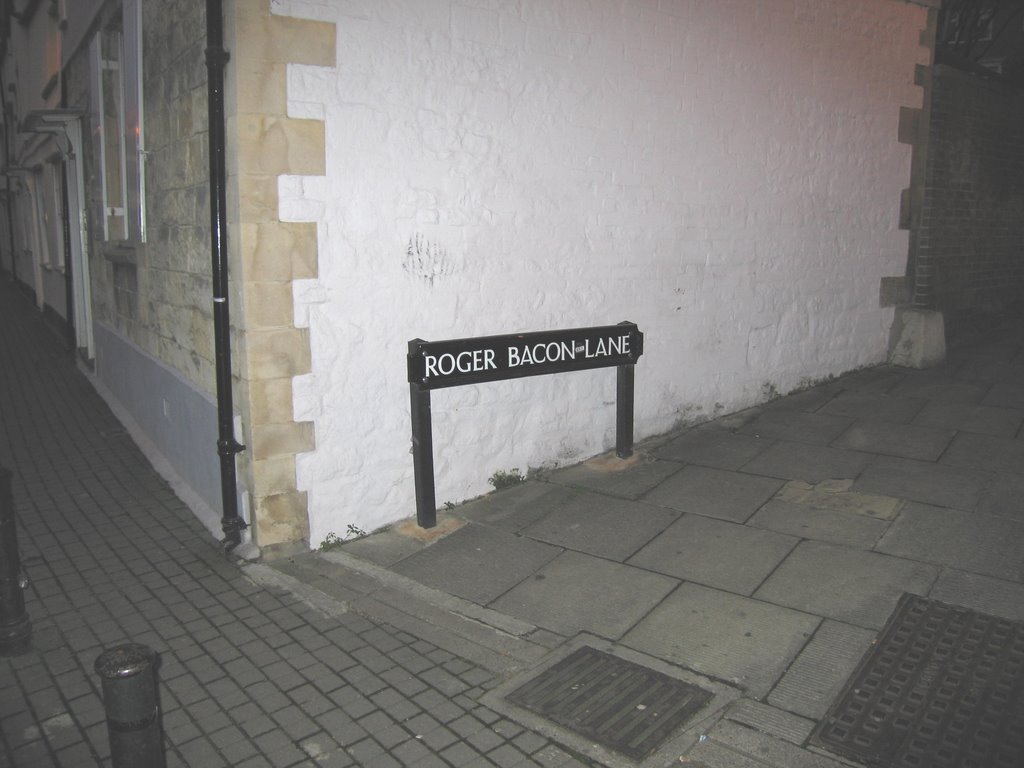
    On an island in the river, where Folly Bridge crosses the Thames, is the site (according to local tradition) of the study of Roger Bacon, the great Franciscan scientist. He is commemorated in a street name. A quaint story relates Bacon's production of a brass head which could answer questions (magically? mechanically?), but due to the incompetenceetance of a laboratory assistant, no questions were asked in time. This talking head has been linked to the famous door-knocker which gives Brasenose its name (see above).

    The Franciscan house was founded by Blessed Agnellus of Pisa, who was admitted to the order and sent to England by St Francis himself, and was buried in Oxford (he died in 1236).
    Later, it produced an early martyr for the Catholic Faith under King Henry VIII, Blessed John Forest, who was the Provincial superior. He was burnt at Smithfield by order of Thomas Cranmer in 1538.

    [1] At the time of writing (1961), considerable alterations are going on in this part of the town. It is possible that some at least of these small remains may be lost. (From Goulder, Pilgrimage Pamphlets: Oxford & Cambridge, 1963)
    [2] Bishop of Hereford 1275-1282.
    [3] Archbishop of Canterbury 1279-1292.
    [4] Lived c. 1214-1294.
    [5] Lived c. 1339-1410.
    [6] For more information on the influence of the friars at Oxford, see Part I of this pamphlet (2nd edition), pp. 41-43.

    Labels: , ,

    THE FRIARS OF THE SACK

    The Friars of the Sack[1] had a monastery on the south of Paradise Street behind the second church of St Budoc. (From Goulder, Pilgrimage Pamphlets: Oxford & Cambridge, 1963)

    [1] The Friars of Penitence. In England they were popularly known as the Friars of the Sack because their habits were made of that material. They were suppressed by the council of Lyons in 1274, but the English houses were not affected by this. At the dissolution under Henry VIII, they had five monasteries in this country.

    Labels: ,

    OSNEY ABBEY

    The abbey stood for the most part on the site of the Western Region station. It was the largest of the Oxford religious houses, and was founded by Robert d’Oilly the younger in 1129. It was served by the Canons Regular of St Augustine and became an abbey in 1154. Dissolved in 1539, its church was used as a cathedral for Henry VIII’s new diocese of Oxford in the years between 1541 and 1545, when the seat of the bishop was moved to the other great church of the Black Canons in the town – St Frideswide’s.

    As soon as the change was made, the demolition of the abbey buildings began. The final blow was struck in modern times by the Great Western Railway, which laid its track right across the site. On the far side of the railway, there are still a few signs of the monastery. Beyond the railway bridge on the left is Mill Street. Here are some small remnants, scattered over the ground between the cemetery and the mill. There is also a small bridge which once belonged to the canons. (From Goulder, Pilgrimage Pamphlets: Oxford & Cambridge, 1963)

    Osney Abbey was host to a number of synods, including the Council of Oxford of 1222, which applied the decisions of the Fourth Lateran General Council to England. Its last Abbot, Henry King, was a relative of the King’s chief minister Thomas Cromwell, and was imposed in order to ensure a smooth dissolution; he was rewarded by being made Bishop of Oxford. He had been a Cistercian at Rewley, and performed the job of undertaker-Abbot at the monasteries of Brewerne and Thame as well as Osney. He made no objection ro the Marian restoration of Catholicism, and died in 1557.

    The mill has given way to houses. For a picture of what a doorway of the abbey looked like early in the 20th Century, in what is now Osney Marina (at the end of Mill Street), see here.

    Labels: ,

    REWLEY ABBEY

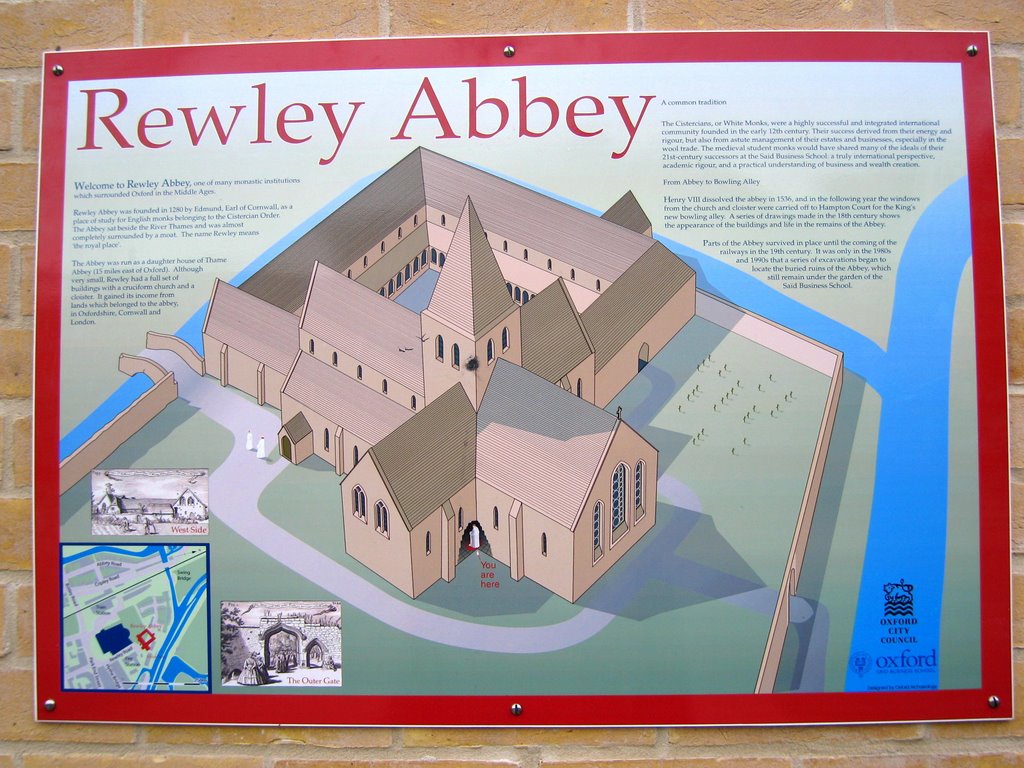
    At the western end of Hythe Bridge Street is a small cul-de-sac, called Rewley Road. Here, on the site of the old London, Midland and Scottish Railway station, stood Rewley Abbey, a Cistercian monastery founded by Edmund,[1] earl of Cornwall, as a studium for the White Monks. It became an abbey in 1281 and was dissolved in 1536. Most of it had disappeared by 1600. The site is now occupied entirely by the station and a coal yard. Up to a few years ago, a section of wall and a doorway survived on the west side of Rewley Road.
    Returning along Hythe Bridge Street, we come to Worcester Street. (From Goulder, Pilgrimage Pamphlets: Oxford & Cambridge, 1963)


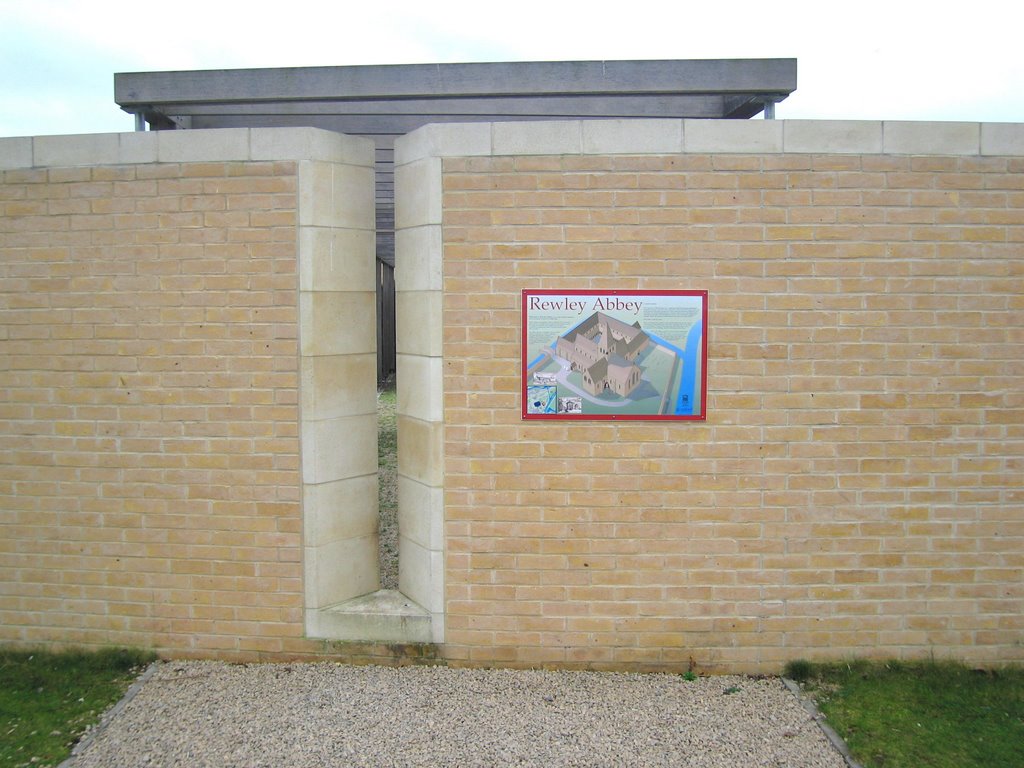
    The London, Midland and Scottish Railway station has been removed, and the area is now occupied by St Frideswide Square and the Saïd Business School (named after an Arab benefactor); Rewley Road now leads past the latter to a new housing development. In the building of the Business School, the remains of Rewley Abbey were discovered in what is now its ‘Fellows’ Garden’. A information board in Rewley Road, on the Saïd Business School garden wall, records this and shows a plan of the Abbey buildings. See here.

    [1] Lived 1250-1300. Nephew of Henry III (reigned 1216-1272).

    Labels: ,

    THE CARMELITE PRIORY

    It is said that St Simon Stock[1] came to Oxford as a student about 1244. In the following year, he was elected prior general of the Carmel­ites at Aylesford in Kent. In 1254, Nicholas de Meules,[2] castellan of Oxford Castle, gave the Carmelites some land on the south side of Stockwell Street. This piece of ground is now occupied by the small Pump Quadrangle of Worcester College and the new buildings.

    This phase of the foundation did not last long. About 1289, Edward I made over the royal palace of Beaumont to the friars. The palace stood in what is now the angle formed by Walton Street and Beaumont Street. The approximate boundaries of the new property would have been Alfred Street on the north, St Giles’ Street and Magdalen Street on the east, George Street on the south, and Worcester Street and Walton Street on the west. It was a large precinct and, in 1321, the Carmelites sold their old land and house to the Benedictines who were looking for more space to expand Gloucester Hall which stood next door.

    Edward I tried to ensure that the Whitefriars of Beaumont took their place in the university. He insisted that at least twenty-four of the friars in residence should be conversant with theology and he undertook to provide eight marks each year towards the keep of each one of them. The friars experienced a great deal of hostility from the canons of Osney Abbey, who objected to what they considered the intrusion of another order into a part of Oxford they had regarded as their own.

    In 1318, the friars obtained permission to build a chapel for them­selves on the south side of St Mary Magdalene’s Church in Magdalen Street. Access to it was through a narrow lane on the east side of the precinct, known to this day as Friars’ Entry. A great part of the ground – known in the middle ages as Brokenheys, and now occupied by the bus station – was part of the Whitefriars’ estate. (From Goulder, Pilgrimage Pamphlets: Oxford & Cambridge, 1963)

    Recent excavations suggest that the Carmelites had their own, substantial church on the Beaumont site. St Simon Stock, the greatest General Superior of the Carmelites, was favoured with a vision of the Blessed Virgin and her promise with regard to the Brown Scapular. For St Simon, see here. The ‘bus station’ referred to is that of Gloucester Green. The name ‘Brokenheys’ means ‘broken hedges’, referring to the abandoned nature of the area following the Black Death. The site of Beaumont Palace is marked by an inscription, recently restored, on the corner of Beaumont Street and Walton Street. The great crusading King, Richard I, Coeur de Lion, was born here in 1157, and his brother King John in 1167. Gloucester Green was also the scene of the execution of two Protestant dissenters, ‘Levellers’, by Cromwellian troops in 1649.

    [1] Lived c. 1165-1265. His longevity appears to be authentic.
    [2] Died c. 1264.

    Labels: ,

    WORCESTER COLLEGE

    Worcester College is a complex institution. In 1298, a small house of studies, belonging to the abbey of Gloucester since 1291, was ex­panded into a college intended to serve all the Black Monks of the Canterbury province. The land was given by John, Lord Giffard,[1] and Gloucester Hall became Gloucester College. Until the dissolution, it was governed by the general chapter of the English Benedictines, and the chief monasteries contributed to its upkeep. In 1321, there was a further expansion when the monks bought up the site of the original Ox­ford Carmel, left empty after the migration of the friars to Beaumont.

    After the dissolution, the buildings lay unused for some time but, in 1560, they were put in order and occupied by another body of students. The new foundation adopted the title of Gloucester Hall and lasted until 1714, when Sir Thomas Cookes,[2] baronet, left directions in his will for refounding it as Worcester College. After this the hall, chapel, loggia, the buildings along the north of the main quad­rangle, and the provost’s lodgings were built, while those in Pump Quadrangle were raised in height.

    The chief point of interest here is the fifteenth-century buildings of the Benedictine college. These stand chiefly on the south side of the main quadrangle, but the present senior common room, at the extreme north-east corner of the quadrangle, is of the same period. The south range of the main quadrangle provides the earliest example of the stair­case system. This is now the rule in all Oxford colleges, where living­ quarters are divided into houses, each with a staircase giving access to several sets of rooms. The custom originated because the various abbots who had students in the college did not wish their bright young men to be corrupted by contact with bright young men from other monasteries. Such is human nature!

    Each monastery, then, had its own house in the one college. Some of the badges belonging to the various abbeys are still in place over the doorways of the houses which their students occupied. If you walk along the south range of the main quadrangle from the end nearer the gatehouse to the passage leading into the garden, you will see the griffon of Malmesbury, argent a cross sable of St Augustine’s Canterbury, Glastonbury has vert a crosslet argent and a quarter argent charged with a Virgin and Child, the three cups or chalices probably represent Pershore. The college has a beautiful garden and lake.

    From Worcester College our route is along Beaumont Street, at the top of which we turn left into St Giles’ Street where we started. (From Goulder, Pilgrimage Pamphlets: Oxford & Cambridge, 1963)

    In 1579 Gloucester had as its Principal Dr Christopher Bagshaw, a former Fellow of Balliol (and student of St John's Cambridge). Bagshaw susequently converted while in France and became a seminary priest, and while in prison at Wisbech Castle became a leader of the 'Appellant' party seeking (vainly) some accomodation with the Government by criticising the Jesuits, at the end of the reign of Queen Elizabeth.

    William Bishop, who was a student at Gloucester Hall from 1570-74, trained in Douai and Rome and returned to England as a priest. Like Bagshaw, he was a member of the Appellant party, but was in 1623 made the first Vicar Apostolic of England. (He was appointed Bishop of Chalcedon in partibus infidelium, with authority covering England.) The system of Vicars Apostolic continued until the Restoration of the Hierarchy in 1850.

    For more on Worcester College and its history, see their site.


    [1] Lived 1232-1299.
    [2] Died 1701.

    Labels: ,