Waynflete took over an ancient hospital, dedicated to St John the Baptist, the blocked-up doorway of which still stands on the street. The chapel of the hospital is incorporated in the range of buildings next to the roadway. On the quadrangle side, it stretches from the pulpit[1] to a point opposite the south-east corner of the ante-chapel. The kitchen, which is on the Cherwell[2] side of the great quadrangle, is either late thirteenth- or early fourteenth-century, and must have been there before the foundation of the college. The other domestic buildings near it are modern.
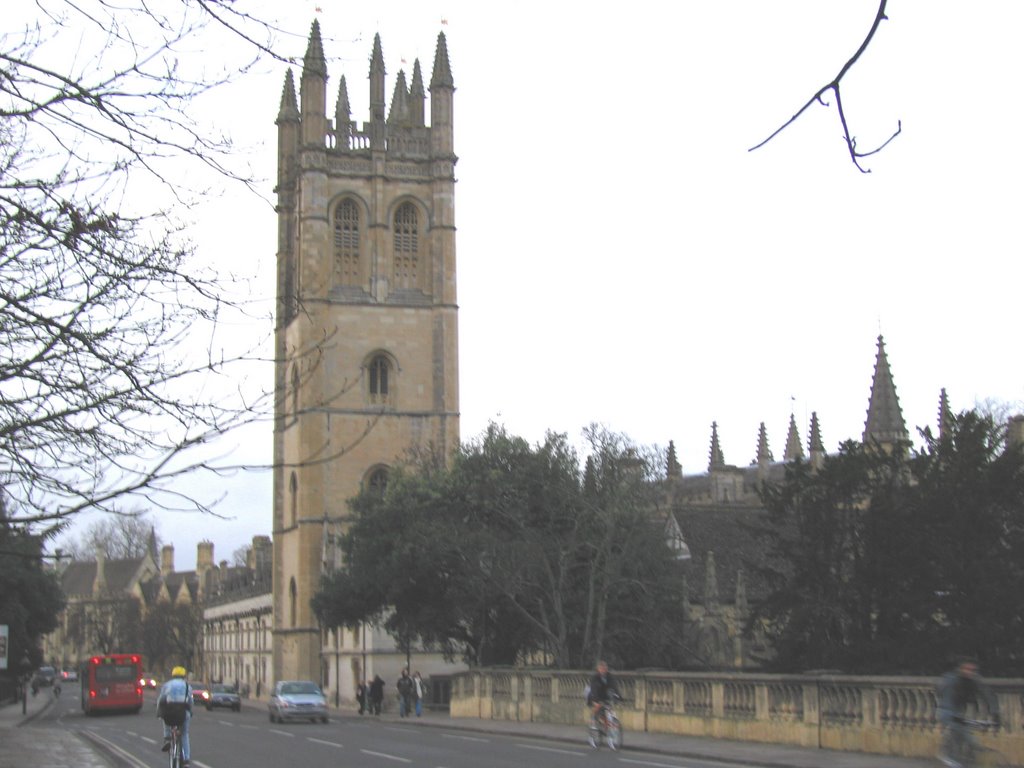
The great quadrangle with its lodgings, the chapel, the hall, the Muniment Tower over the passage into the cloister from St John’s Quadrangle, and the Founder’s Tower a short way down the west cloister are all of the fifteenth century, though the external walls of the north and east cloister lodgings were rebuilt in the eighteenth. The bell tower[3] – possibly constructed when Wolsey was bursar – and the street range, apart from the ancient hospital chapel, with part of the president’s lodgings on the north side of St John’s Quadrangle are sixteenth-century. The chapel is very fine. Over the west front are restored figures of St John the Baptist, Edward IV,[4] St Mary Magdalene and William of Waynflete. In pre-Reformation times, there were seven altars inside. There is a restored reredos and some good brasses and misericords in the ante-chapel. The hall has some magnificent woodwork.
The buildings on the left, as you enter the first quadrangle, are modern and stand on the site of the ancient grammar school founded soon after 1480. This institution later grew into Magdalen Hall which, however, had no connection with the college. In 1820, it was destroyed by fire and, two years later, it was resurrected on the site of the present Hertford College. Beyond the cloister, there is an unenclosed quadrangle with a beautiful range of buildings, dating from 1733, on the far side. Perhaps the most charming feature of the place is the long water-walk, called Addison’s[5] Walk, which lies on the east side of the college. To the west is the deer park.
Magdalen, in Reformation times, was at first loyal to the old religion, but later became a stronghold of Puritanism. It was, however, faithful to the Stuarts, though it put up a stout resistance to James II’s attempt to force Catholicism on it.(From Goulder, Pilgrimage Pamphlets: Oxford & Cambridge, 1963)
Magdalen men were martyred for the Faith by Henry VIII: Blessed Thomas Abel, a chaplain and defender of Queen Catherine (1540) and the Franciscan Anthony Brookby (judicially strangled in 1537). At that time the college Fellows were split between Catholic conservatives and reformers. The college successfully resisted the order to dissolve the choir and grammar school in 1549; however, the Master, Owen Oglethorpe, was forced to resign in 1552, by
 Protestant Fellows who proceeded to strip the chapel of its Catholic fittings and vestments. (As Bishop of Carlisle, Oglethorpe later became famous as the only bishop in England prepared to crown Queen Elizabeth. He remained Catholic, however, and was soon deprived of his see.) Later, it hosted the foreign Protestants Bucer and Peter Martyr. Under Queen Mary, Oglethorpe was restored, and the composer John Sheppard was choirmaster. Under Elizabeth it had a Puritan Master, and under Charles I a High Church one; most of the Fellows were expelled when the King was defeated in the Civil War, and were restored by Charles II. James II, as was the custom, proposed a new Master in 1687, the college Fellow Anthony Farmer, who was a Catholic. The Fellows refused to elect him, and a major conflict ensued, at the height of which the King expelled 25 recalcitrant Fellows; however, he soon reinstated them, and indeed soon had to flee the country himself, in 1688. (From Goulder, Pilgrimage Pamphlets: Oxford & Cambride, 1963)
The seminary priest Ven. William Freeman, martyred in 1595, was a alumnus. The Protestant hagiographer John Fox studied at Magdalen. Later, the Anglican apologist C.S. Lewis was Fellow of the college.
For more on the history of Magdalen College, see their site.
[1] A sermon is preached from this pulpit on St John the Baptist's day, June 24th.
[2] A tributary of the Thames, rising north of Banbury.
[3] A hymn is sung by Magdalen choir from the top of this tower each year on May Day at dawn. The origin of this custom is obscure.
[4] Reigned 1461-1483.
[5] Lived 1672-1719. Essayist and poet. He was a member of the college. Joseph Addison.
No comments:
Post a Comment